Map the Block › Data › Places
Abortion Laws by State (2026) and Abortions per Year
What each state's abortion law allows today, its exceptions and penalties, and how many abortions happen there each year.
As of October 16, 2026: Banned (nearly all stages): 13 states; Banned after ~6 weeks: 4 states; Banned after 12-18 weeks: 3 states; Banned after 20-22 weeks: 3 states; Legal to viability: 18 states; Legal, no gestational limit: 9 states and DC.
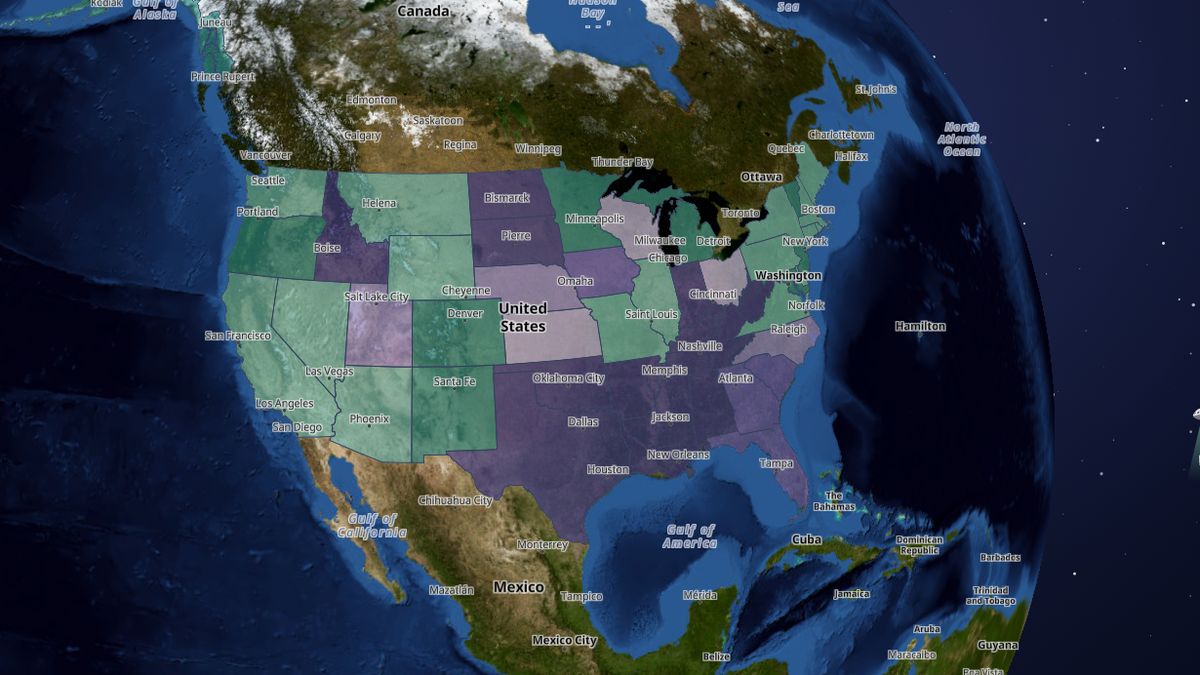 Open the live map →
⚖️States by category
📜Every state
| State | Law | What it says | Abortions (latest year) |
|---|---|---|---|
| Alabama | Banned (nearly all stages) | Banned (nearly all stages). Limit: None at any stage (exceptions only) Exceptions: Life: yes. Health: serious risk of substantial physical impairment of a major bodily function (confirmed in writing by a second physician; a serious mental illness qualifies only with a psychiatrist's documentation). | 7,520 (2025) |
| Alaska | Legal, no gestational limit | Legal, no gestational limit. Limit: No limit in state law Exceptions: No gestational limit, so no exceptions apply. Life: n/a. | 1,720 (2025) |
| Arizona | Legal to viability | Legal to viability. Limit: Viability (Ariz. Const. | 17,600 (2025) |
| Arkansas | Banned (nearly all stages) | Banned (nearly all stages). Limit: None at any stage (exceptions only) Exceptions: Life: yes (medical emergency from a physical disorder, illness or injury). Health: no. | 3,630 (2025) |
| California | Legal to viability | Legal to viability. Limit: Viability (Cal. Health & Safety Code 123466; Cal. | 187,560 (2025) |
| Colorado | Legal, no gestational limit | Legal, no gestational limit. Limit: No limit in state law Exceptions: No gestational limit, so no exceptions apply. Life: n/a. | 22,820 (2025) |
| Connecticut | Legal to viability | Legal to viability. Limit: Viability (Conn. Gen. | 15,000 (2025) |
| Delaware | Legal to viability | Legal to viability. Limit: Viability (24 Del. C. | 4,080 (2025) |
| District of Columbia | Legal, no gestational limit | Legal, no gestational limit. Limit: No limit in District law Exceptions: No gestational limit, so no exceptions apply. Life: n/a. | 8,330 (2025) |
| Florida | Banned after ~6 weeks | Banned after ~6 weeks. Limit: 6 weeks gestational age, counted from the first day of the last menstrual period (Fla. Stat. | 64,510 (2025) |
| Georgia | Banned after ~6 weeks | Banned after ~6 weeks. Limit: Once embryonic or fetal cardiac activity is detectable (about 6 weeks after last menstrual period) Exceptions: Life: yes (medical emergency). Health: serious risk of substantial and irreversible physical impairment of a major bodily function, not mental or emotional. | 38,000 (2025) |
| Hawaii | Legal to viability | Legal to viability. Limit: Viability (HRS 453-16 defines abortion as termination of a nonviable fetus) Exceptions: After viability: termination 'necessary to protect the life or health of the pregnant person'. Rape/incest and fetal anomaly: no separate post-viability exception. | 3,740 (2025) |
| Idaho | Banned (nearly all stages) | Banned (nearly all stages). Limit: None at any stage (exceptions only) Exceptions: Life: yes (physician's good-faith judgment that abortion is necessary to prevent death; risk of self-harm excluded). Health: no. | 810 (2025) |
| Illinois | Legal to viability | Legal to viability. Limit: Fetal viability, as judged by the treating health care professional (775 ILCS 55/1-25(a)) Exceptions: Before viability: no restriction on reason. After viability: life or health of the patient (health read broadly; Guttmacher notes it covers physical, emotional, psychological and familial health and age). | 87,210 (2025) |
| Indiana | Banned (nearly all stages) | Banned (nearly all stages). Limit: None at any stage (exceptions only); abortion is a criminal act except in listed circumstances (IC 16-34-2-1, SEA 1 of 2022) Exceptions: Life: yes. Health: serious physical health risk (no mental-health basis), before the earlier of viability or 20 weeks post-fertilization (~22 LMP). | 4,300 (2025) |
| Iowa | Banned after ~6 weeks | Banned after ~6 weeks. Limit: Once fetal cardiac activity is detectable by abdominal ultrasound (about 6 weeks after last menstrual period) (Iowa Code 146E.2) Exceptions: Life: yes (medical emergency). Health: serious risk of substantial and irreversible impairment of a major bodily function; psychological/emotional conditions excluded (146A.1). | 3,050 (2025) |
| Kansas | Banned after 20-22 weeks | Banned after 20-22 weeks. Limit: 22 weeks gestational age, measured from the first day of the last menstrual period (K.S.A. 65-6724, 65-6723(d)) Exceptions: Life: yes. | 20,700 (2025) |
| Kentucky | Banned (nearly all stages) | Banned (nearly all stages). Limit: None at any stage (exceptions only) (KRS 311.772); a 6-week cardiac-activity law (KRS 311.7706) is also in force Exceptions: Life: yes, death or substantial risk of death from a physical condition. Health: only to prevent serious, permanent impairment of a life-sustaining organ. | 3,370 (2025) |
| Louisiana | Banned (nearly all stages) | Banned (nearly all stages). Limit: None at any stage (exceptions only) (La. R.S. | 9,350 (2025) |
| Maine | Legal to viability | Legal to viability. Limit: Viability; after viability an abortion may be performed when a licensed physician judges it necessary (22 M.R.S. sec. | 2,700 (2025) |
| Maryland | Legal, no gestational limit | Legal, no gestational limit. Limit: No limit in state law: the State may not interfere before viability, or at any time for life/health or serious fetal anomaly (Md. Health-Gen. | 38,850 (2025) |
| Massachusetts | Legal to viability | Legal to viability. Limit: 24 weeks ('pregnancy has existed for less than 24 weeks') (M.G.L. c. | 22,150 (2025) |
| Michigan | Legal, no gestational limit | Legal, no gestational limit. Limit: No limit in state law; the constitution allows regulation after fetal viability, but KFF and Guttmacher report no gestational ban in effect (Mich. Const. | 38,820 (2025) |
| Minnesota | Legal, no gestational limit | Legal, no gestational limit. Limit: No limit in state law (Protect Reproductive Options Act, Minn. Stat. | 15,950 (2025) |
| Mississippi | Banned (nearly all stages) | Banned (nearly all stages). Limit: None at any stage (exceptions only) (Miss. Code 41-41-45); 6-week, 15-week and 20-week laws also remain Exceptions: Life: yes (preservation of the mother's life). | 6,290 (2025) |
| Missouri | Legal to viability | Legal to viability. Limit: Fetal viability, as judged in good faith by the treating health care professional (Mo. Const. | 3,420 (2025) |
| Montana | Legal to viability | Legal to viability. Limit: Viability (Mont. Const. | 2,510 (2025) |
| Nebraska | Banned after 12-18 weeks | Banned after 12-18 weeks. Limit: 12 weeks gestational age, counted from the first day of the last menstrual period (Neb. Rev. | 3,860 (2025) |
| Nevada | Legal to viability | Legal to viability. Limit: 24 weeks after the commencement of pregnancy (fixed 24-week limit, NRS 442.250) Exceptions: After 24 weeks: allowed if the physician has reasonable cause to believe it is necessary to preserve the life or health of the pregnant woman (must be in a licensed hospital). | 16,100 (2025) |
| New Hampshire | Legal to viability | Legal to viability. Limit: 24 weeks probable gestational age (fixed 24-week limit, RSA 329:44) Exceptions: After 24 weeks: life; serious risk of substantial and irreversible impairment of a major bodily function (physical conditions); fetal abnormalities incompatible with life. Rape/incest: no. | 2,560 (2025) |
| New Jersey | Legal, no gestational limit | Legal, no gestational limit. Limit: No limit in state law Exceptions: Not applicable (no gestational limit). | 61,490 (2025) |
| New Mexico | Legal, no gestational limit | Legal, no gestational limit. Limit: No limit in state law Exceptions: Not applicable (no gestational limit). | 16,160 (2025) |
| New York | Legal to viability | Legal to viability. Limit: 24 weeks from the commencement of pregnancy, or later if there is an absence of fetal viability (N.Y. Pub. | 111,790 (2025) |
| North Carolina | Banned after 12-18 weeks | Banned after 12-18 weeks. Limit: After the 12th week of pregnancy (G.S. 90-21.81A); the statute does not say LMP or post-fertilization (KFF and CRR read it as 12 weeks LMP) Exceptions: Life/health: medical emergency (death or serious risk of substantial and irreversible physical impairment of a major bodily function; not psychological). | 47,930 (2025) |
| North Dakota | Banned (nearly all stages) | Banned (nearly all stages). Limit: None at any stage (exceptions only) Exceptions: Life: yes. Health: 'serious health risk' = substantial physical impairment of a major bodily function, not psychological. | 370 (2025) |
| Ohio | Banned after 20-22 weeks | Banned after 20-22 weeks. Limit: 20 weeks post-fertilization (about 22 weeks LMP) (R.C. 2919.201); separate post-viability ban (R.C. | 32,250 (2025) |
| Oklahoma | Banned (nearly all stages) | Banned (nearly all stages). Limit: None at any stage (exceptions only) Exceptions: Life: yes (physician's reasonable medical certainty or probability that the pregnancy will endanger her life). Health: no. | 3,850 (2025) |
| Oregon | Legal, no gestational limit | Legal, no gestational limit. Limit: No limit in state law Exceptions: Not applicable (no gestational limit). | 13,380 (2025) |
| Pennsylvania | Legal to viability | Legal to viability. Limit: 24 weeks gestational age, counted from the first day of the last menstrual period (fixed 24-week limit, 18 Pa.C.S. 3211; 3203) Exceptions: After 24 weeks: to prevent death or substantial and irreversible impairment of a major bodily function (physical; second physician must concur, must be in a hospital). | 37,850 (2025) |
| Rhode Island | Legal to viability | Legal to viability. Limit: Fetal viability as determined by the attending physician (R.I. Gen. | 3,640 (2025) |
| South Carolina | Banned after ~6 weeks | Banned after ~6 weeks. Limit: Once embryonic/fetal cardiac activity is detected (about 6 weeks after last menstrual period; S.C. Code 44-41-630, as read by the S.C. | 7,840 (2025) |
| South Dakota | Banned (nearly all stages) | Banned (nearly all stages). Limit: None at any stage (exception for the patient's life only) Exceptions: Life: yes ('necessary to preserve the life of the pregnant female'). Health: no separate health exception. | 400 (2025) |
| Tennessee | Banned (nearly all stages) | Banned (nearly all stages). Limit: None at any stage (exceptions only) Exceptions: Life: yes. Health: to prevent 'serious risk of substantial and irreversible impairment of a major bodily function'; a 2025 amendment defines this term and 'inevitable abortion' (e.g. | 7,570 (2025) |
| Texas | Banned (nearly all stages) | Banned (nearly all stages). Limit: None at any stage (exceptions only) Exceptions: Life: yes. Health: physical only - a licensed physician may act when a 'life-threatening physical condition' places the patient at risk of death or 'serious risk of substantial impairment of a major bodily function'; 2025 SB 31 says the risk need not be imminent and drops the best-chance-of-survival method requirement from the exception; ectopic pregnancy and miscarriage care are not abortion. | 41,870 (2025) |
| Utah | Banned after 12-18 weeks | Banned after 12-18 weeks. Limit: 18 weeks gestational age, measured from the first day of the LMP (Utah Code 76-7-302, 76-7-301) Exceptions: Life: yes. Health: 'serious physical risk of substantial impairment of a major bodily function'. | 5,560 (2025) |
| Vermont | Legal, no gestational limit | Legal, no gestational limit. Limit: No limit in state law Exceptions: Not applicable: no gestational limit, so no exceptions are needed at any stage. | 1,480 (2025) |
| Virginia | Legal to viability | Legal to viability. Limit: End of the second trimester (third-trimester limit; Va. Code 18.2-74) - a fixed trimester rule, not a viability test Exceptions: Third trimester: allowed in a licensed hospital if the physician and two consulting physicians certify that continuing the pregnancy is likely to cause death or 'substantially and irremediably impair the mental or physical health' of the woman; life support must be available if there is evidence of viability. | 40,230 (2025) |
| Washington | Legal to viability | Legal to viability. Limit: Viability of the fetus (RCW 9.02.110) Exceptions: After viability: allowed to protect the pregnant individual's life or health (health not limited to physical). Rape/incest and fatal fetal anomaly: no separate exceptions. | 23,690 (2025) |
| West Virginia | Banned (nearly all stages) | Banned (nearly all stages). Limit: None at any stage (exceptions only) Exceptions: Life: yes (medical emergency). Health: 'serious risk of substantial life-threatening physical impairment of a major bodily function', psychological conditions excluded; ectopic pregnancy allowed. | 770 (2025) |
| Wisconsin | Banned after 20-22 weeks | Banned after 20-22 weeks. Limit: 20 weeks probable post-fertilization age (about 22 weeks LMP) (Wis. Stat. | 8,110 (2025) |
| Wyoming | Legal to viability | Legal to viability. Limit: Viability (W.S. 35-6-502, as enacted by 2026 HB0126 Article 5, certified in effect May 2026); the 6-week rule (35-6-401 to -404) is enjoined Exceptions: After viability: allowed only 'when necessary to preserve the woman from an imminent peril that substantially endangers her life or health'. | 450 (2025) |
🔎About this data
State abortion law as of 2026-10-16: the gestational limit now enforced, its exceptions and penalties, with the statute. Where a stricter ban is blocked by a court but a lesser limit is enforced, the state is shaded by the enforced limit and the blocked ban is described in the popup. Yearly counts are abortions by the state where they happened (not where the patient lives): CDC Abortion Surveillance 2013-2022 (the newest CDC year published); a few states do not report to CDC, so those years come from the Guttmacher Institute's Abortion Provider Census when it published a figure for that year, labelled non-official, and are left blank otherwise (never estimated). Years after the newest CDC year are Guttmacher Institute Monthly Abortion Provision Study estimates (non-official, rounded to 10); they count telehealth abortions in the state where the pills were received, including those prescribed from other states, which is why some states with bans show counts. Not legal advice.
Source: State statutes; CDC Abortion Surveillance; gaps and 2023-2025 from Guttmacher Institute (non-official)
Coverage: All 50 states and DC
How it was checked: Law as of 2026-10-16, drafted from statute text on official legislature code sites (or the enacted bill/act PDF, court notices and official ballot pages) for 46 of 51 jurisdictions. CA, DC, IN, OK and TN official code hosts refuse or block us, so those rest on official secondary pages (CA Legislative Analyst, OK Attorney General memo) plus KFF/Guttmacher/CRR cross-checks. 327 quoted checks were re-matched by script against the saved pages (308 matched exactly or letter-for-letter; the rest are summaries of cross-check tables), and the operative limit was read by hand in the statute or ruling for 17 states. Every state was compared with KFF, Guttmacher or the Center for Reproductive Rights: 12 differences remain and are explained in the popups (e.g. WY, where KFF still lists a 6-week limit that a court blocked on 2026-04-24). Counts: every CDC year 2013-2022 adds up to CDC's stated national total (2014 off by 1 inside CDC's own table); 30 random CDC rows, all 23 Guttmacher gap-fill rows and all 153 Guttmacher 2023-2025 rows were re-read from the source tables and match. 16 state-years (CA, MD, NH 2015/2018/2021/2022; NJ 2021-2022; WY 2015, 2018) are left blank because no reliable source states a figure.
💬Questions and answers
Abortion laws by state: how many states?
As of October 16, 2026: Banned (nearly all stages): 13 states; Banned after ~6 weeks: 4 states; Banned after 12-18 weeks: 3 states; Banned after 20-22 weeks: 3 states; Legal to viability: 18 states; Legal, no gestational limit: 9 states and DC.
Banned (nearly all stages): which states?
13 states: Alabama, Arkansas, Idaho, Indiana, Kentucky, Louisiana, Mississippi, North Dakota, Oklahoma, South Dakota, Tennessee, Texas, West Virginia.
Banned after ~6 weeks: which states?
4 states: Florida, Georgia, Iowa, South Carolina.
Banned after 12-18 weeks: which states?
3 states: Nebraska, North Carolina, Utah.
Banned after 20-22 weeks: which states?
3 states: Kansas, Ohio, Wisconsin.
Where does this data come from?
State statutes; CDC Abortion Surveillance; gaps and 2023-2025 from Guttmacher Institute (non-official). Coverage: All 50 states and DC.
Is the map free to use?
Yes. Map the Block is free, with no ads or paywall. You may quote figures with credit to Map the Block (maptheblock.com); for bulk or commercial use there is a Data API.
🧭More maps like this
Keep the map free. Map the Block has no ads and no paywall. Donations pay for the server and the data work.
Numbers computed from the live map data on October 18, 2026. Free to quote with credit to “Map the Block (maptheblock.com)”; see reuse terms.